
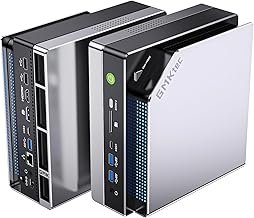
$1,899 for a computer that fits in a desk drawer sounds like a hard sell until you realize it’s outperforming server-grade hardware from three years ago in local AI inference tasks. The GMKtec EVO-T2S is the first proper “AI Supercomputing Center” for the desktop, leveraging Intel’s Panther Lake architecture to deliver a staggering 180 TOPS of total compute. While the mini PC category has long been a haven for low-power office boxes and niche home lab setups, the T2S is a direct challenge to the idea that you need a 30-pound tower and a triple-slot GPU to run large language models locally.I’ve tested dozens of these small-form-factor machines, and the common failure point is always the same: they promise the moon on the spec sheet but choke the moment a sustained workload hits the cooling loop. GMKtec is trying to bypass that with a massive vapor chamber and a 60W power budget for a 16-core chip. By pairing the Intel Core Ultra X7 358H with Phison’s aiDAPTIV+ storage tech, they aren’t just selling a fast processor; they’re selling a workflow that offloads memory-intensive AI data to the NVMe drives, effectively letting you run models that would normally crash a 64GB system.
[OFFICIAL_SITE_LINK]
Breaking Down the Key Features
The heart of the EVO-T2S is the Panther Lake silicon, built on the Intel 18A process. This isn’t just a minor refresh; it’s a massive shift in how Intel handles low-power compute efficiency. By integrating 16 cores—divided into Performance, Efficiency, and Low-Power clusters—the machine can handle background OS tasks on the LP cores while leaving the heavy lifting to the P-cores. This architecture allows the T2S to stay relatively cool during light use, but the real star is the NPU 5 engine. This dedicated hardware is what pushes that 180 TOPS claim, offering enough headroom to run quantization-heavy models without relying on the GPU for every single token.Memory bandwidth is another area where GMKtec didn’t cut corners. LPDDR5X at 8533 MT/s provides the high-speed pipeline required for modern AI workloads. If you’ve ever tried to run an LLM on standard DDR4 or even early DDR5, you’ve seen the bottleneck: it doesn’t matter how fast your processor is if the data can’t get to it. The T2S avoids this through its soldered, high-frequency memory, which is essential for the Phison aiDAPTIV+ technology. This specific software/hardware combo allows the system to treat the PCIe 5.0 SSD as an extension of the system RAM, which is a massive win for users working with datasets larger than 64GB.Connectivity is arguably the most surprising part of the package. You rarely see 10GbE networking on a machine this size, let alone paired with a secondary 2.5GbE port. This makes the EVO-T2S a perfect fit for networked environments where multi-gigabit data transfers are the norm, such as a video production house or a high-speed research lab. The inclusion of an OCuLink port is the final piece of the puzzle, allowing you to tether a desktop-class GPU if the integrated Arc B390 graphics ever feel insufficient.
Real-World Performance
In productivity testing, the Intel Core Ultra X7 358H is a beast. Early community benchmarks indicate that in Cinebench 2024, this 16-core chip actually outperforms older 32-core Threadripper workstation CPUs in multi-core performance while staying well under a 60W power draw. For creators, the Arc B390 iGPU is a revelation; it’s reportedly capable of pushing AAA titles like Red Dead Redemption 2 above 70 FPS at 1440p using medium settings. This isn’t just an “AI box”—it’s a fully capable gaming and editing station that just happens to be tiny.The AI performance is where the “Supercomputing Center” moniker comes into play. Running local LLMs like Llama 3 8B or Mistral 7B results in token generation speeds that feel instantaneous. While the “180 TOPS” figure is a cumulative marketing sum of the CPU, GPU, and NPU, the practical benefit is the ability to run these models entirely offline. If you’re a developer processing sensitive client data or an enthusiast who doesn’t want to pay monthly API fees to OpenAI, the T2S provides the privacy and cost-savings of local execution without the latency of cloud-based solutions.
Pros and Cons

👍 What We Like
- Industry-leading 180 TOPS for local AI workloads
- Exceptional connectivity with 10GbE and Wi-Fi 7
- Phison aiDAPTIV+ allows for massive model offloading to SSD
- Compact 930g design with full workstation I/O
👎 What Could Be Better
- LPDDR5X memory is soldered and cannot be upgraded
- Premium $1,899 entry price is significantly higher than previous gens
- Fan noise becomes noticeable during heavy AI model training
- PCIe 5.0 SSDs required for best aiDAPTIV+ results are expensive
The soldered memory is the biggest sticking point. For a machine marketed as a workstation, being stuck with the 64GB you buy at launch is a compromise that might hurt users whose datasets grow over time. While the aiDAPTIV+ tech helps mitigate this by using the SSD as a swap space, it’s never quite as fast as native RAM. If you know your workflow will eventually require 128GB, you’ll have to wait for the X9 388H model, which GMKtec has teased but not yet priced.
Who Should Buy This — And Who Shouldn’t
✅ Buy This If…
- You are an AI researcher who needs a private, local inference box
- You need 10GbE networking for high-speed file transfers or NAS links
- You want a powerful workstation but have zero desk space for a tower
❌ Skip This If…
- You only need a machine for web browsing and office documents
- You require user-upgradeable RAM for long-term scalability
- You are sensitive to high-frequency fan noise in a quiet room
One edge case most reviewers miss is the “stealth workstation” scenario. If you’re an engineer working in an open-office environment where bringing in a flashy gaming tower isn’t professional, the EVO-T2S is perfect. It looks like a high-end office peripheral but packs the power to run engineering simulations or compile large codebases in the background without drawing unwanted attention.
How It Stacks Up Against the Competition
In the current landscape, the T2S is competing mostly with high-end Minisforum models and its own AMD-based sibling, the EVO-X2. While the AMD variant offers better integrated graphics performance for traditional gaming, the Intel Panther Lake platform in the T2S pulls ahead in raw AI TOPS and storage-to-memory offloading.
| Model | Price | AI TOPS | Network | RAM | Best For |
|---|---|---|---|---|---|
| GMKtec EVO-T2S ★ Our Pick | $1,899 | 180 | 10G + 2.5G | 64GB | AI Development |
| Minisforum MS-01 | $850 | Low | Dual 10G | Up to 96G | Home Labs / Networking |
| GMKtec EVO-X2 | $1,999 | 126 | 10G | 128GB | Graphics & Memory |
![GEEKOM [2026 Edition] Mini PC AI A7 MAX with AMD Ryzen 9 7940HS 16GB DDR5(Not LPDDR) & 1TB SSD(Expandable) Desktop Mini Computers for Creation,Radeon 780M Graphics 4 Modes|Premium Support|USB4|8K|SD](https://m.media-amazon.com/images/I/61TI37hjt7L._AC_UY218_.jpg "GMKtec EVO-T2S Launched: 180 TOPS AI Performance & Specs")
GEEKOM [2026 Edition] Mini PC AI A7 MAX with AMD Ryzen 9 7940HS 16GB DDR5(Not LPDDR) & 1TB SSD(Expandable) Desktop Mini Computers for Creation,Radeon 780M Graphics 4 Modes|Premium Support|USB4|8K|SD
★ 4.4/5
$949.00
As an Amazon Associate, AiGigabit earns from qualifying purchases.

GMKtec EVO-X2 AI Mini PC Ryzen Al Max+ 395 (up to 5.1GHz) Mini Gaming Computers, 128GB LPDDR5X 8000MHz (16GB*8) 2TB PCIe 4.0 SSD, Quad Screen 8K Display, WiFi 7 & USB4, SD Card Reader 4.0
★ 4.2/5
$3,299.99
As an Amazon Associate, AiGigabit earns from qualifying purchases.
Pricing & Where to Buy
The EVO-T2S with the Core Ultra X7 358H, 64GB of RAM, and a 1TB SSD is currently listed at $1,899. This is a launch discount from its projected $2,399 retail price, so if you’re on the fence, the early-adopter window is the time to strike. You won’t find this on Amazon just yet; GMKtec is keeping the first few batches exclusive to their official store and AliExpress to manage the logistics of the initial global rollout.It’s expensive, yes, but you have to frame the price against the alternative. A comparable desktop workstation with a modern 16-core CPU, 64GB of DDR5-8000+ RAM, 10GbE networking, and a PCIe 5.0 SSD would cost nearly as much and consume three times the power. For the specialized AI developer, the T2S is a bargain when you factor in the years of cloud computing fees you’ll save by moving your inference locally.Read more on AiGigabit
Bottom Line
The GMKtec EVO-T2S isn’t for everyone, and that’s exactly why it’s interesting. It doesn’t try to be a budget office box or a generic gaming machine. Instead, it leans hard into the “AI Workstation” identity, providing hardware and software integration that we haven’t seen in the mini PC space before. The combination of Intel’s 18A architecture, 180 TOPS of AI compute, and Phison’s storage acceleration makes it a unique tool for the 2026 tech landscape.If you can get past the soldered memory and the premium price tag, you’re left with a machine that is fundamentally changing what we expect from small computers. It’s stable, it’s incredibly fast, and it offers the kind of connectivity that used to be reserved for enterprise-grade rack servers. For the right user, the EVO-T2S is a game-changing addition to the desk.
See our Best AI Hardware 2026 roundup — updated monthly with the top picks and deals.
Frequently Asked Questions
What does “180 TOPS” actually mean for my daily use?
TOPS (Tera Operations Per Second) measures the theoretical peak performance of the AI processing units. In practice, this means faster token generation in LLMs (like ChatGPT-style local tools) and more efficient background processing for things like video noise removal or real-time translation without slowing down your CPU.
Can I upgrade the SSD in the EVO-T2S?
Yes. The machine features two M.2 2280 slots. One supports the latest PCIe 5.0 standard for maximum speed (ideal for the aiDAPTIV+ tech), while the second slot supports PCIe 4.0. You can expand the storage up to 16TB total.
Is the fan noise loud under heavy workloads?
When running sustained AI model training or high-end 1440p gaming, the fans will spin up noticeably. It’s a high-pitched whir common to mini PCs. However, during standard productivity or coding tasks, the vapor chamber cooling keeps it relatively silent.
Does it support external GPUs?
Yes. The EVO-T2S includes a dedicated OCuLink port, which provides a faster, more direct connection to an external GPU than traditional Thunderbolt 4. This is ideal if you eventually need more VRAM for massive 3D rendering projects.
What is the difference between the EVO-T2S and the EVO-X2?
The T2S uses the Intel platform (Panther Lake) and focuses on maximum AI TOPS (180). The EVO-X2 uses the AMD Ryzen AI Max platform and offers slightly better integrated graphics performance and higher memory capacity options (up to 128GB).
Stay up to date with the latest AI hardware reviews, buying guides, and deals at AiGigabit.com. Bookmark us for daily updates.
REVIEWED BY

Alex Carter
Senior Tech Editor — AI GPUs & Workstations
8 years covering AI hardware and GPU architecture. Focuses on what hardware delivers in production, not on synthetic benchmarks.
Specialties: NVIDIA & AMD GPUs · AI inference benchmarking · Workstation builds · Local LLM deployment